

DEMETER BLOOMINGThe ceramic tradition has a vital and rich history harking back to Antiquity. To practice ceramics today is to enter a conversation that began before written language, and to insist that conversation is not finished. It has never been more urgent than now.
DEMETER is the Ancient Greek goddess of grain and agriculture, Mother Earth, her name rooted in "meter" (mother) and "De" or "Ge" (Earth). She bore Persephone with Zeus. The myth is unsparing: Demeter's fury at her daughter's abduction by Hades fractures the seasons; her reclamation of Persephone restores spring's abundance. Chloë, from the Greek for "young green shoot," turns toward that fierce renewal and Demeter's generative power.
BLOOMING is the refusal to disappear into the algorithm. It is making with your hands when everything pushes toward the virtual, the outsourced, the mass-produced. It is the friction of clay resisting you, the slowness that culture tells you to optimize away. Creating is a refusal, an insistence on presence, craft, and the irreplaceable mark of human hands.
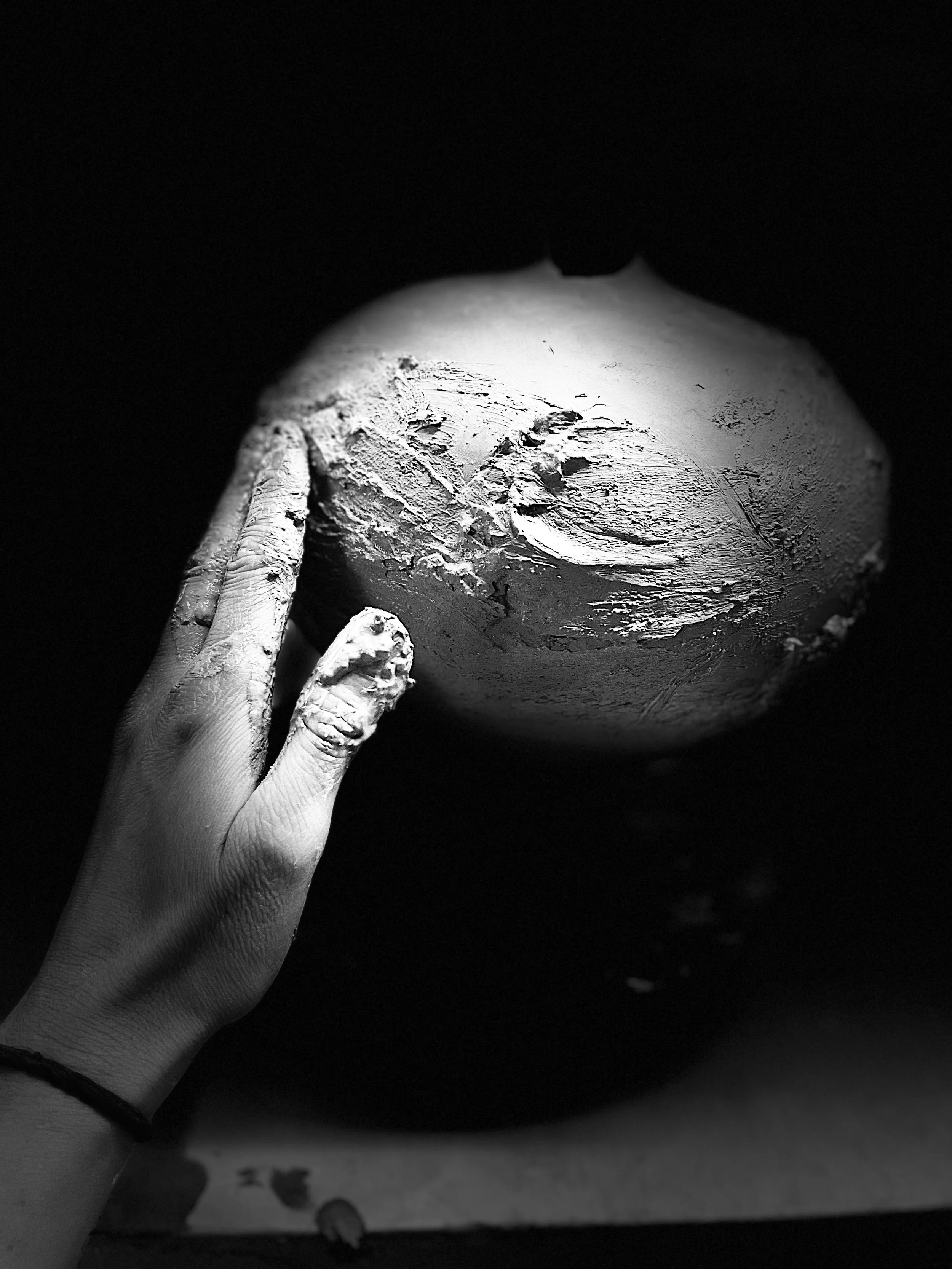
STATEMENTMy work lives in productive contradiction. The surfaces are rough, encrusted, almost unruly, yet the forms beneath are classical in their proportion, thin-walled and intentionally light. Mess and refinement are not opposites here, but collaborators. The crust is not decoration; it is the argument. Each piece is shaped as much by improvisation and chance as by intention: surfaces allowed to accumulate, salt allowed to bubble and burst, becoming something the hand didn't entirely plan. What emerges holds two truths at once, weathered and considered, wild at the surface and quietly composed at the bone.
This contradiction is not accidental. It is shaped by a life lived between cultures. Born in London, raised in Hong Kong within a French tradition, I carry both a wabi-sabi sensibility, which finds beauty in asymmetry, imperfection, and transience, and the classical proportion of a Western aesthetic education. These philosophies assert themselves into one another. I don't resolve them. I hold them together in every piece, grounded always in close observation of the natural world, which offers an aesthetic language that crosses cultures and speaks to something we share.
Clay is one of the oldest materials humans have shaped with their hands. I work with it because of what it asks of you: presence, patience, and a willingness to listen. My vessels are hand-coiled, built slowly, layer by layer, using a technique unchanged since prehistoric times. I discover each piece's vulnerabilities and strengths as I build, and carry that knowledge into the next one. The process itself is the philosophy made physical: slowness as resistance, improvisation as trust, the body as instrument.
Most human traditions share a creation story rooted in earth. Adam formed from dust. The first man in Islam shaped from a handful of soil containing portions of every variety on earth. Clay connects us to that oldest story of what it means to be made, and to make. Objects formed from one of the earth's most fragile materials are transformed by fire into something that outlasts us, evidence of a particular thought, a particular time, a particular life. Holders of time, memory, and the quiet crossings of a life lived between worlds. Eventually they too return to silence and to the ground from which they came. In that arc, from earth, through hands, through fire, back to earth, I find something that feels true about being human, and about why making still matters.
“There is a vitality, a life force, a quickening that is translated through you into action, and there is only one of you in all time, this expression is unique, and if you block it, it will never exist through any other medium; and be lost. The world will not have it. It is not your business to determine how good it is, not how it compares with other expression. It is your business to keep it yours clearly and directly, to keep the channel open. You do not even have to believe in yourself or your work. You have to keep open and aware directly to the urges that motivate you. Keep the channel open. ”
—Martha Gaham
BIOGRAPHYChloë Le Pichon is a ceramic artist, curator, and art advisor whose work — in the studio and beyond it — is rooted in a single conviction: that handmade objects matter, and that the artists who make them deserve to be seen and supported.
Of French and Chinese heritage, born in London and raised in Hong Kong within a French educational tradition, Chloë graduated from Swarthmore College with a BA in Studio Art, where she discovered ceramics under the mentorship of Professor Syd Carpenter and teacher Doug Herren. She has maintained an independent studio practice ever since, producing sculptural and functional work exhibited in Philadelphia, New York, and national juried exhibitions. Her collaborations include a project with florist Missi Flowers for Altuzarra. She continues to deepen her practice through intensives in France, where traditional ceramic techniques and contemporary design sensibilities converge in ways that resonate with her own aesthetic language.
She has worked as a technician and teaching artist with The Clay Studio's Claymobile program, bringing ceramics directly to communities across Philadelphia, and teaches private lessons to children and adults. Her early investigations into natural building and sustainable architecture using clay further deepened her material understanding. As gallery director, she extended that support into the professional realm, helping artists navigate pricing, contracts, and market positioning, and sharing that knowledge more broadly as a guest speaker for CraftNOW, SAQA, and other organizations. For Chloë, helping artists build sustainable careers is inseparable from the larger project of keeping craft vital and visible.
As Director of Gravers Lane Gallery, a contemporary craft gallery in Philadelphia, she curated exhibitions and programming and co-founded Chestnut Hill Design Destination, building consistent bridges between contemporary craft, design, and the collectors and communities who engage with both.
She is currently an Art Advisor at Kevin Barry Art Advisory, where she develops art programs for hotels, hospitals, and commercial spaces, building narratives around art and place that bring the work of living artists into the daily lives of the public. It is, at its core, an extension of everything that came before: a commitment to artist visibility, to the belief that creativity and the handmade are not peripheral but essential, and to finding ever wider stages on which that work can be seen and celebrated.